

Design is being transformed by AI, and honestly, that is not entirely a bad thing. Canva put graphic design in the hands of small business owners who never had the budget for a designer. Tools like Midjourney and Firefly let anyone generate polished visuals with a prompt. Claude Code and platforms like Lovable mean that someone with an idea can now build their own app over a weekend, without a developer or a design team.
People are being genuinely empowered. Things that used to require years of training or expensive professionals are now accessible to almost anyone. That is worth appreciating, not resenting.
But here is what most designers noticed: The apps people are building are functional. The visuals they are generating are decent. What they are often missing is a felt sense of how a real person will move through an experience, where they will get confused, what will make them trust something or abandon it. That gap is not a technical problem. It is a human understanding problem.
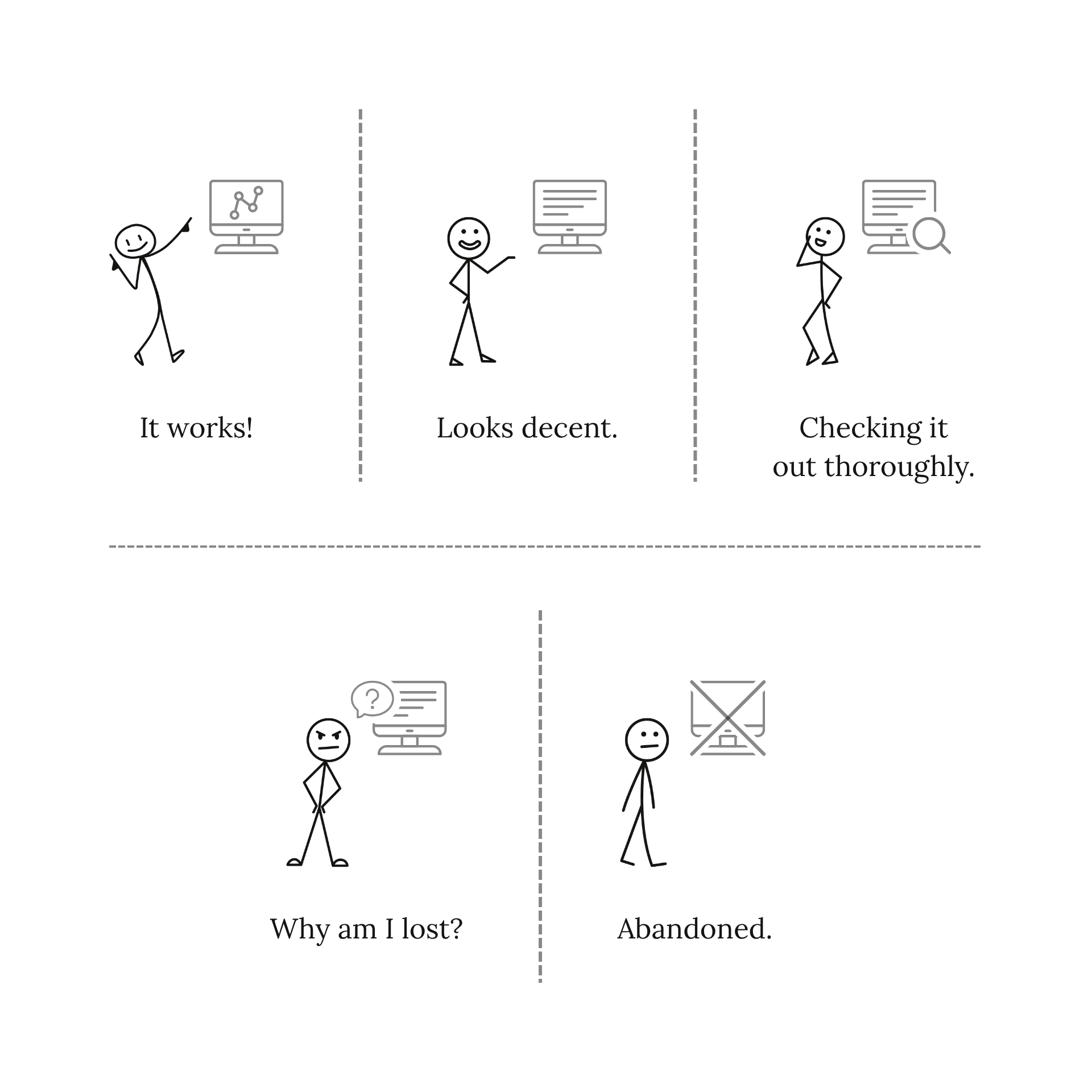
That is what sent me toward UX. Not because AI is the enemy, but because I started asking: what does design mean when the executional parts become automated? What is left that requires genuine understanding of people, not pattern matching on data? The answer, as far as I can tell, is the work of figuring out how humans and products actually meet. That is still deeply human. And that is where I want to be now.
The moment I started looking seriously at UX, I kept running into another term, which I already knew enough about: Human-Computer Interaction, or HCI. They seemed to mean almost the same thing, but the more I read, the more they blurred together. It took a while to understand that the blur is actually the point!
The Relationship
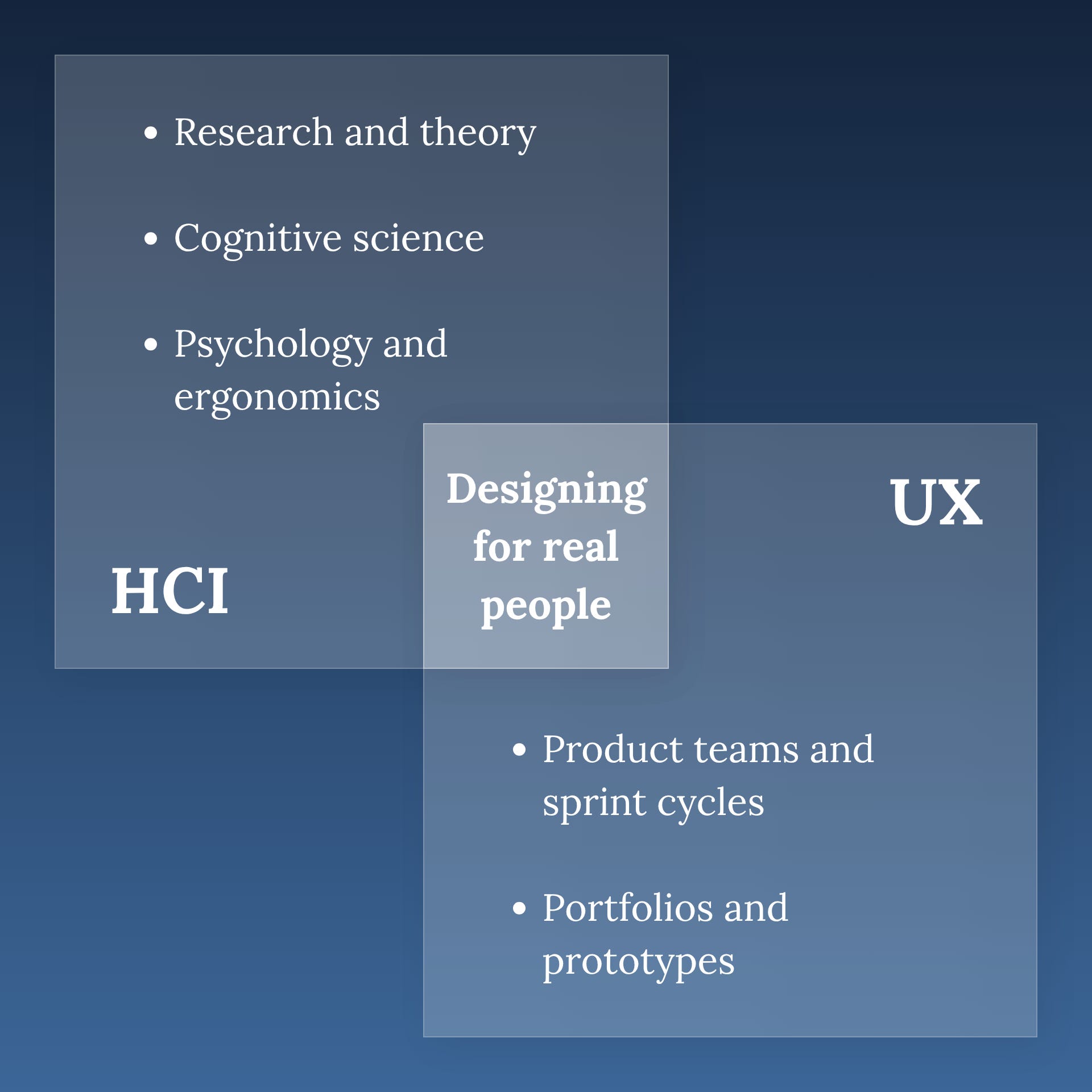
HCI came first. It was born in the research labs and universities of the 1980s. It drew from cognitive science, psychology, and ergonomics to ask a fundamental question: how do people actually interact with machines, and how can that interaction become more natural? It was, at its core, a scientific discipline. It produced frameworks, theories, and empirical findings.
UX grew out of that research, but moved into the world of products and companies. Where HCI asked “why does this work the way it does?”, UX asked “how do we make this feel right to use?” One generates knowledge. The other applies it.
Just as MBBS is the science behind becoming a surgeon, HCI is the science behind becoming a UX designer.
Research versus practice
In concrete terms, HCI researchers spend years studying how memory, attention, and decision-making shape the way we use interfaces. UX designers take those findings and apply them to make a button placement feel obvious, a form feel effortless, a flow feel inevitable. Concepts like cognitive load, Hick’s Law, Fitts’s Law, all rooted in HCI research, quietly sit behind every good design decision.
HCI lives mostly in academic papers and long-term studies. UX lives in product teams, design critiques, and sprint cycles. The timelines, the outputs, and the audiences are different. But the underlying questions are the same: how do humans and technology meet, and how do we make that meeting better?
Why I stopped trying to separate them
Here is what I have come to think, at least for now: the distinction matters most when you are deciding what kind of career to build. If you are drawn to understanding human behaviour at a fundamental level and are comfortable with slow, iterative research, HCI might be your home. If you want to shape the products people use every day and thrive on tangible, fast feedback, UX is probably the right path.
But once you are actually doing the work, the separation stops mattering. You are just solving problems. A UX designer reaching for the right solution will inevitably use HCI concepts. They just will not always name them. The label falls away, but the thinking stays.
Don Norman spent his career as living proof of this. He came from cognitive science and HCI research, then wrote The Design of Everyday Things, the book that brought those ideas into the hands of practitioners everywhere. His career is essentially the argument that you cannot be a great designer without understanding the science, and you cannot do good science without staying curious about real people using real things.
On A Concluding Note…
I am not there yet. I am at the stage where I need to build things, get feedback, and grow a portfolio. HCI, for now, is something I am aware of rather than deep in. But I find it reassuring to know it is there, a foundation I can grow into when practice starts raising questions I cannot answer on instinct alone.
The curiosity will know when to pull me deeper.
Readings:
Laws of UX by Jon Yablonski - HCI principles made practical for designers
The Design of Everyday Things by Don Norman - The essential bridge between HCI and practice
What is UX? by Nielsen Norman Group - A clean, practitioner-focused definition
HCI overview by Interaction Design Foundation - A thorough introduction to the field
IxDF Blog - The World’s Largest Free Online Resource on UX Design